

How Much Cash to Buy a Home in the Twin Cities
By Dan Winters
How much cash do you need to buy a home in the Twin Cities?
Buying a home in the Twin Cities requires more upfront cash than just a down payment. You'll also need to cover closing costs, prepaid taxes and insurance, inspection and appraisal fees, earnest money, and post-closing reserves. The exact total depends on your loan program, the purchase price, your closing date, and your lender's requirements, but breaking it into separate buckets makes the number far less intimidating.
Key Takeaways
The Twin Cities regional median sales price was $404,950 in August 2026, according to the Minneapolis Area Realtors Weekly Market Activity Report, your required cash scales with the price you negotiate.
Minnesota Housing's one-unit purchase-price limit in the 11-county Twin Cities metro is $515,200, effective July 1, 2026, meaning most Twin Cities purchases fall within program eligibility.
Earnest money is not an added cost, it is an early use of cash that gets credited back toward what you owe at closing if the transaction proceeds.
Your lender's Closing Disclosure is the only reliable source for your exact cash-to-close figure; generic estimates can be significantly off depending on your closing date and escrow requirements.
Minnesota Housing's Start Up program income limits for the 11-county metro are $131,500 for one or two people and $151,200 for households of three or more, for loans locked on or after July 1, 2026.
What are all the upfront costs when buying a home in the Twin Cities?
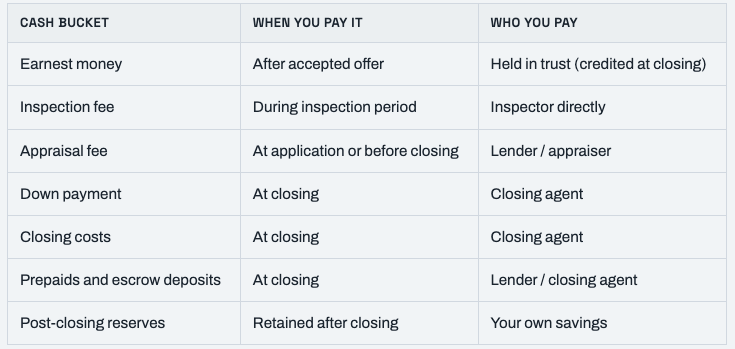
Every buyer I work with asks some version of this question, and it's the right one to start with. When you're buying a home in the Twin Cities, the cash you need doesn't live in one place, it's spread across several buckets, each with its own timing and purpose. Here's how I walk my clients through it.
Down payment
Your down payment is the largest single piece, and it's set by your loan program and the purchase price you negotiate. Conventional loans can go as low as 3% down for qualifying first-time buyers. FHA loans require 3.5% with qualifying credit. VA and USDA loans can go to zero down for eligible borrowers. Jumbo loans typically require more.
With the Twin Cities regional median at $404,950 as of August 2026, even a 5% down payment on a median-priced home is a meaningful sum. The right down-payment amount for your situation depends on your loan program, your monthly payment goals, and whether you're using assistance, not just what the minimum allows. For a broader look at how the purchase price fits your overall budget, my complete home buying budget guide walks through the full picture.
Earnest money
Earnest money is the good-faith deposit you put down after your purchase agreement is accepted. In Minnesota, the amount is negotiated in the purchase agreement, there's no fixed requirement. In practice, I typically see buyers in the Twin Cities offer somewhere in the range of $1,000 to $5,000 or more depending on the price point and the competitiveness of the offer, but what matters most is what makes your offer credible to the seller.
Here's the important part: earnest money is not an extra cost. If the transaction closes, it's credited toward your total funds due at closing. It's an early use of cash, not an additional expense on top of everything else. The purchase agreement controls what happens to it if the deal falls through.
Inspection
A home inspection is paid during the inspection period, typically within a few days of an accepted offer, and it's separate from your closing costs. It's one of the most important things you'll spend money on in the entire process. The inspection evaluates the property's condition for your benefit, and it's your primary tool for understanding what you're buying before you're committed.
The cost varies by property size and inspector. Your lender won't usually appear on the Closing Disclosure for this one, you'll pay the inspector directly. Budget for it as a standalone line item.
Appraisal
If you're financing the purchase, your lender will order an appraisal to confirm the property's value supports the loan amount. The appraisal fee is typically collected before closing, sometimes at the time of application, sometimes billed separately. It serves the lender's interests, not yours specifically, but it's part of the cost of getting a mortgage. It will show up on your Loan Estimate.
Closing costs
Closing costs cover the lender charges, title insurance, recording fees, and other transaction costs associated with completing the purchase. The Minnesota Attorney General's Home Buyer's Handbook identifies title insurance, loan-origination charges, homeowner's insurance premiums, mortgage-insurance premiums, property taxes, and the mortgage-registration tax among the items that can appear at closing.
Your lender is required to give you a Loan Estimate early in the process that itemizes these costs. Review it carefully. Some charges are fixed; others can vary. Comparing Loan Estimates from multiple lenders is one of the most effective ways to reduce this number.
Prepaids and escrow deposits
Prepaids are costs you pay at closing that cover the period between closing and when your regular monthly payments begin. This typically includes prepaid homeowner's insurance, prepaid mortgage interest for the remainder of the closing month, and initial deposits into your escrow account for property taxes and insurance.
The amount depends heavily on your closing date. Closing at the end of the month minimizes prepaid interest. Closing earlier in the month means more days of interest to prepay. Your property's tax cycle and insurance premium also factor in. As the Minnesota Attorney General notes, the lender's final Closing Disclosure is the controlling document for what you'll actually owe, generic estimates can be meaningfully off.
Post-closing reserves
This is the bucket most first-time buyers underestimate. After closing, you should have cash remaining for moving costs, immediate repairs or updates, and a general emergency fund. Some loan programs also require documented reserves as part of underwriting. I always tell buyers: getting into the home is one thing, but being financially stable once you're there is what makes homeownership work long-term.
There's no universal rule for how much to keep in reserve, but the answer is never zero. Think through what your home might need in the first year and plan accordingly.
Does Minnesota Housing help with down payment and closing costs for Twin Cities buyers?
Yes, and it's one of the most underused resources I see buyers overlook. Minnesota Housing offers homebuyer programs through participating lenders that can provide down-payment and closing-cost assistance. The specific product, maximum assistance amount, repayment terms, and underwriting requirements vary by program, so the details matter.
Purchase-price limits in the 11-county metro
For an eligible one-unit property in the 11-county Twin Cities metro, the Minnesota Housing purchase-price limit is $515,200, effective July 1, 2026. For a two-unit property, the limit is $659,550. With the regional median at $404,950 as of August 2026, most Twin Cities purchases fall well within the one-unit ceiling.
One important note: the 11-county metro definition is specific. Not every property marketed as "Twin Cities" falls within the counties Minnesota Housing includes. Confirm the property's county qualifies before counting on program eligibility.
Income limits for Start Up and Step Up
Under the Minnesota Housing program changes effective July 1, 2026, the Start Up program income limits for the 11-county metro are $131,500 for a one- or two-person household and $151,200 for a household of three or more. The Step Up program, designed for repeat buyers or those who don't qualify for Start Up, carries a metro income limit of $196,600 for all household sizes.
Eligibility depends on the specific program, the borrower's circumstances, and the participating lender's underwriting. These limits are a starting point, not a guarantee of approval. If you think you might qualify, the right move is to connect with a participating lender and run through the details, I can point you in the right direction.
For a full walkthrough of the purchase process from offer to closing, see How to Buy a Home in Minneapolis.
Frequently Asked Questions
How much money do I need upfront to buy a house in Minneapolis or St. Paul?
The total upfront cash for a Twin Cities purchase includes your down payment, closing costs, prepaids, inspection, appraisal, earnest money, and post-closing reserves. The exact amount depends on your loan program, the purchase price, your closing date, and your lender's escrow requirements, your lender's Loan Estimate and final Closing Disclosure are the only reliable sources for your specific number.
Can I buy a Twin Cities home with 3% down?
Yes, some conventional loan programs allow as little as 3% down for qualifying first-time buyers, and FHA loans require 3.5% with qualifying credit. A lower down payment reduces the cash you need upfront but typically increases your monthly payment and may require mortgage insurance. Minnesota Housing assistance programs may also help reduce the cash required at closing for eligible buyers.
What is the Minnesota Housing purchase-price limit in the Twin Cities?
For a one-unit property in the 11-county Twin Cities metro, the Minnesota Housing purchase-price limit is $515,200, effective July 1, 2026. The two-unit limit is $659,550. These limits apply to properties in the specific counties Minnesota Housing defines as the metro area, confirm your property's county qualifies before relying on program eligibility.
Does Minnesota Housing help with closing costs and prepaid taxes?
Minnesota Housing's homebuyer programs can provide assistance toward down payment and closing costs through participating lenders. The available product, maximum assistance, and repayment terms vary by program. Income limits for the Start Up program in the 11-county metro are $131,500 for one or two people and $151,200 for three or more, for loans locked on or after July 1, 2026. A participating lender can walk you through what's available for your situation.
How much earnest money is normal in Minnesota, and do I get it back if the inspection finds a problem?
Earnest money in Minnesota is negotiated in the purchase agreement, there's no fixed amount required by law. Whether it's returned if a problem surfaces during inspection depends entirely on the terms of your purchase agreement, including any inspection contingency. If the transaction closes, earnest money is credited toward your funds due at closing, so it's not an added cost, it's an early use of cash.
How much should I keep in savings after closing on a Twin Cities home?
There's no universal rule, but the answer is never zero. Some loan programs require documented reserves as part of underwriting, and beyond that, you'll want a cushion for moving costs, immediate repairs, and unexpected expenses in the first year. Think through your specific home's condition and your financial situation, your lender can tell you if your program has a minimum reserve requirement.
Every buyer I work with in the Twin Cities comes to this question from a different starting point, different savings, different loan programs, different timelines. The buckets are the same for everyone, but the numbers inside each one are yours specifically. The only way to know your actual cash-to-close figure is to run it with a lender who can give you a real Loan Estimate and with an agent who knows what to expect at each stage of the process.
If you're ready to figure out what buying a home in the Twin Cities actually looks like for your situation, I'd be glad to walk through it with you. Schedule a consultation and we'll start with the numbers that matter for your move.
About Dan Winters
Dan Winters is a Minneapolis REALTOR® and founder of The Winters Real Estate Group at Coldwell Banker Realty, serving buyers and sellers throughout Minneapolis, Saint Paul, and the greater Twin Cities metro. Licensed since 2013, Dan has guided clients through more than 350 transactions and $120 million in real estate sales, consistently ranking among the top 3–5% of REALTORS® in the Twin Cities. His approach is straightforward: real estate with clarity, not pressure. Every agent on The Winters Real Estate Group is a full-time professional committed to honest advice, skilled negotiation, and protecting each client's time, equity, and priorities.
Equal Housing Opportunity. This article is general information only and does not constitute legal, tax, or financial advice. Confirm your specific costs and program eligibility with your closing agent, tax advisor, or lender.