

Which Twin Cities Neighborhoods Got Imagine 2050 Grants
By Dan Winters
Which Twin Cities neighborhoods could benefit from Imagine 2050 grants?
In August 2026, the Metropolitan Council announced $12.045 million in grants to 34 projects across 21 cities and townships in the Twin Cities region, explicitly framed as advancing the Imagine 2050 regional plan. Awarded communities include Minneapolis, Saint Paul, Brooklyn Center, Brooklyn Park, Bloomington, Blaine, Edina, Falcon Heights, Hopkins, New Brighton, Oakdale, Saint Louis Park, South Saint Paul, White Bear Lake, and Woodbury. The grants fund affordable rental housing, homeownership opportunities, preservation of existing affordable homes, and community-centered commercial projects, meaning the effects vary significantly by project type and stage.
Key Takeaways
The Metropolitan Council awarded $12.045 million to 34 projects in 21 Twin Cities cities and townships in August 2026 under the Imagine 2050 framework.
Twenty-four of those awards were development grants totaling $11.31 million, covering new construction, rehabilitation, preservation, and community commercial spaces.
Minneapolis and Saint Paul are the highest-confidence starting points for neighborhood research, but the award announcement does not identify every specific neighborhood, project-level documents do.
A grant award signals planned public investment, not a guaranteed change in property values, construction timelines, or zoning, project stage matters enormously.
Torre de San Miguel in Saint Paul, a 142-home community, received grant support for critical repairs, a real example of how these awards preserve existing affordable housing rather than only build new units.
What is Imagine 2050, and why do these grants matter for buyers and sellers?
Imagine 2050 is the Metropolitan Council's long-range framework covering land use, housing, transportation, water resources, and regional parks across the seven-county Twin Cities metro. Think of it as the region's planning blueprint through mid-century. When a city or project receives a grant explicitly tied to this framework, it signals that the investment is aligned with regional priorities, not just a one-off local decision.
For buyers, that alignment matters. Areas receiving Livable Communities grants are places where public and public-supported investment is actively moving. For sellers, it's worth understanding what's happening in your neighborhood or in adjacent ones, both because it can affect how you position a home and because buyers will ask.
That said, I want to be direct about something I tell every client who brings this up: a grant award is not a guarantee of anything. It's a signal worth tracking, not a prediction of price appreciation or a construction start date.
What kinds of projects do these grants fund?
The Metropolitan Council's 2026–2027 Annual Plan for Distribution organizes grants into three stages, each with different funding limits and implications for how soon physical change actually happens:
Policy and small-area planning grants (up to $100,000): These influence future zoning and land-use decisions. No construction is imminent, but these are early indicators of where a community is heading.
Early-stage development grants (up to $500,000): A project is taking shape. Site control, feasibility, and design work are typically underway. Construction is still ahead.
Construction-stage development grants (up to $2 million): The strongest signal. A project is moving toward physical work, building, rehabilitating, or preserving housing or commercial space.
The August 2026 round included 24 development grants totaling $11.31 million, according to the Metropolitan Council's announcement. That's a meaningful concentration of development-stage activity across the metro.
Separately, the Metropolitan Council also awarded $3.5 million in Livable Communities grants to six cities for redevelopment projects involving polluted-land cleanup, job creation, and affordable housing, a complementary set of investments worth watching alongside the Imagine 2050 awards.
What does preservation funding actually mean for a neighborhood?
Not every grant creates new units. The Torre de San Miguel example in Saint Paul illustrates this well. That 142-home community received grant support for critical repairs to preserve a safe and dignified living environment, not to build a new complex. Preservation funding keeps existing affordable housing viable, which matters for neighborhood stability and for understanding what kind of change (or non-change) a grant award actually represents.
When I'm working with buyers in areas that have received this kind of funding, I make sure they understand the distinction. Preservation activity looks very different on the ground than new construction does.
How buyers and sellers should actually use this information
The Metropolitan Council's award announcement is a starting point, not a substitute for project-level research. Here's the workflow I walk clients through:
Identify the award recipient and project address. The announcement names cities and townships, but individual project locations require digging into the award descriptions and city planning pages.
Determine the grant category and project stage. Planning grant versus construction-stage award makes a significant difference in how soon you'll see any physical change.
Check the relevant city planning or development page. Look for zoning approvals, permit status, and project schedules. A grant award doesn't mean permits are pulled or a groundbreaking is scheduled.
Verify whether construction, affordability restrictions, or commercial components are actually proceeding. Some projects move quickly; others take years from award to ribbon-cutting.
For buyers, this research helps you understand what a neighborhood is being positioned for, not just what it looks like today. If you're considering a home in Minneapolis or Saint Paul, knowing whether a nearby site has a construction-stage grant versus a planning grant changes how you interpret the neighborhood's near-term trajectory.
For sellers, the question I hear most is whether grant-funded activity nearby helps or complicates a sale. The honest answer is: it depends on the project type, the stage, and how buyers perceive it. A completed affordable housing preservation project nearby is a very different conversation than an active construction site. I'll help you frame it accurately, because buyers will ask, and the way you answer matters.
A note on transportation investment alongside housing grants
It's worth knowing that housing grants aren't the only public investment flowing into the Twin Cities core. According to the Metropolitan Council's Imagine 2050 Transportation Overview, Minneapolis received a $20 million federal Safe Streets and Roads for All implementation grant tied to its Vision Zero Action Plan, while Saint Paul received a nearly $16 million implementation grant in 2024. These are transportation grants, not Livable Communities housing awards, but they reinforce that both core cities are receiving layered public investment across multiple infrastructure categories simultaneously.
That context matters when you're evaluating a neighborhood. Planned investment in streets, safety, housing, and commercial space doesn't move in isolation, and understanding the full picture is part of what I bring to every buyer conversation.
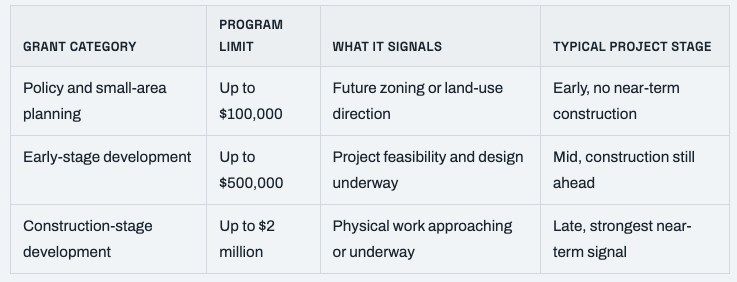
Source: Metropolitan Council 2026–2027 Annual Plan for Distribution. Program limits are maximums, not guaranteed project budgets.
The 2026–2027 program runs two application rounds per year, with most outcomes due April 15 and October 15. An application deadline is not a construction start date, and that distinction is exactly the kind of thing worth clarifying before you draw conclusions about a neighborhood's near-term trajectory. Your specific situation, whether you're buying near a proposed project or selling in a city with an active award, deserves a conversation, not a generalization.
If you're tracking the Twin Cities market more broadly, my 2026 Twin Cities housing market update covers the supply and demand context that shapes how any neighborhood-level investment actually lands for buyers and sellers.
Frequently Asked Questions
Which Minneapolis and Saint Paul neighborhoods are connected to Imagine 2050 grant-funded projects?
Both cities appear in the August 2026 Imagine 2050 grant announcement, but the announcement names cities rather than specific neighborhoods. Identifying the exact neighborhoods requires reviewing individual award descriptions, city planning pages, and project-level documents. Minneapolis and Saint Paul are the highest-confidence starting points for that research.
Do Imagine 2050 grants create more affordable housing or mainly preserve existing homes?
Both. The August 2026 award package funded new affordable rental housing, homeownership opportunities, and preservation of existing affordable communities. The Torre de San Miguel project in Saint Paul, a 142-home community receiving support for critical repairs, is a clear example of preservation funding at work. The mix varies by project, which is why reviewing individual award details matters more than assuming all grants produce new construction.
Could a grant-funded redevelopment project affect home values near the project site?
A grant award identifies an area with planned public or public-supported investment, but the research does not establish a direct causal relationship between any particular award and future home prices. Project type, stage, and execution timeline all influence how a nearby development is perceived by buyers. The defensible framing is opportunity and awareness, not a guaranteed appreciation signal.
How long does it usually take for a Metropolitan Council grant to become a completed project?
It varies significantly by project stage. A planning grant may influence zoning decisions over years without producing construction. An early-stage development grant means a project is in design or feasibility work, with construction still ahead. A construction-stage award is the strongest near-term signal, but even then, permitting, financing, and contractor timelines add time between award and completion. Buyers and sellers should verify the specific project status, proposed, awarded, permitted, under construction, or complete, before drawing neighborhood conclusions.
How can buyers find neighborhoods with planned affordable-housing or infrastructure investment in the Twin Cities?
Start with the Metropolitan Council's Livable Communities Grants page and the August 2026 award announcement for the initial list of recipient cities. From there, check the relevant city's planning or community development department for project addresses, stages, and schedules. Pairing that research with a local agent who tracks these investments at the neighborhood level is the most efficient way to connect grant activity to actual buying decisions.
Imagine 2050 grant awards are one of the clearest public signals of where the Twin Cities region is directing investment, in housing, preservation, redevelopment, and infrastructure. Understanding what those awards actually mean for a specific neighborhood, at a specific project stage, is where the real work happens.
If you're buying or selling in a community that received one of these awards and want to understand what it means for your decision, I'm happy to walk through it with you. Reach out to schedule a conversation, no pressure, just clarity.
About Dan Winters
Dan Winters is a Minneapolis REALTOR® and founder of The Winters Real Estate Group at Coldwell Banker Realty, serving buyers and sellers throughout Minneapolis, Saint Paul, and the greater Twin Cities metro. Licensed since 2013, Dan has guided clients through more than 350 transactions and $120 million in real estate sales, consistently ranking among the top 3–5% of REALTORS® in the Twin Cities. His approach, real estate with clarity, not pressure, extends throughout every agent on his team, all of whom are full-time professionals committed to strong communication, skilled negotiation, and protecting each client's time, equity, and priorities.
Equal Housing Opportunity. This article is general information only and does not constitute legal, tax, or financial advice. Confirm your own numbers and situation with your closing agent, tax advisor, or lender.