

12 Questions to Ask a Listing Agent in Minneapolis
By Dan Winters
What should you ask a listing agent before signing in Minneapolis?
Before hiring a listing agent in Minneapolis, ask about their recent sales in your specific neighborhood, how they build a comparative market analysis, who personally handles photography and negotiations, and what the listing agreement requires of both parties. Twelve targeted questions will separate agents with real local expertise from those with a polished pitch and thin local results.
Key Takeaways
Neighborhood-specific sales history matters more than metro-wide transaction counts, experience in one Minneapolis submarket does not automatically transfer to another.
Under Minnesota Statutes § 82.67, a listing agent represents and acts on behalf of the seller, so confirming who personally handles pricing, negotiation, and communication is a legitimate and important question.
Minnesota's agency disclosure is not a contract, but the listing agreement you sign afterward likely is, ask about duration, termination rights, and post-agreement obligations before you put pen to paper.
The highest offer is not always the strongest offer; ask any prospective agent to walk you through how they compare price, financing type, contingencies, and concessions together.
Verified local market data for the Twin Cities extends through August and September 2026, ask agents to show you current figures, not statistics from a prior year.
Choosing a listing agent in Minneapolis is one of the highest-stakes decisions in the home-selling process. The wrong choice can mean a longer time on market, a price reduction you didn't plan for, or a negotiation handled by someone who doesn't know your neighborhood. The right choice means a clear strategy, honest pricing, and someone who protects your interests at every step.
I've been on both sides of this conversation, as the agent being interviewed and as the advisor helping sellers prepare for those interviews. These twelve questions are the ones that actually separate strong local agents from agents who just sound good in a living room.
Before you sit down with anyone, it helps to understand what you're actually hiring for. A listing agent in Minneapolis isn't just a person who puts your home on the MLS. Under Minnesota Statutes § 82.67, a seller's broker represents and acts on behalf of the seller, that means pricing strategy, marketing execution, negotiation, and protecting your equity throughout the transaction.
Questions about experience and local market knowledge
Start here. This is where you find out whether an agent's track record is actually relevant to your home.
1. How many homes have you listed and sold in my specific neighborhood in the past 12 months?
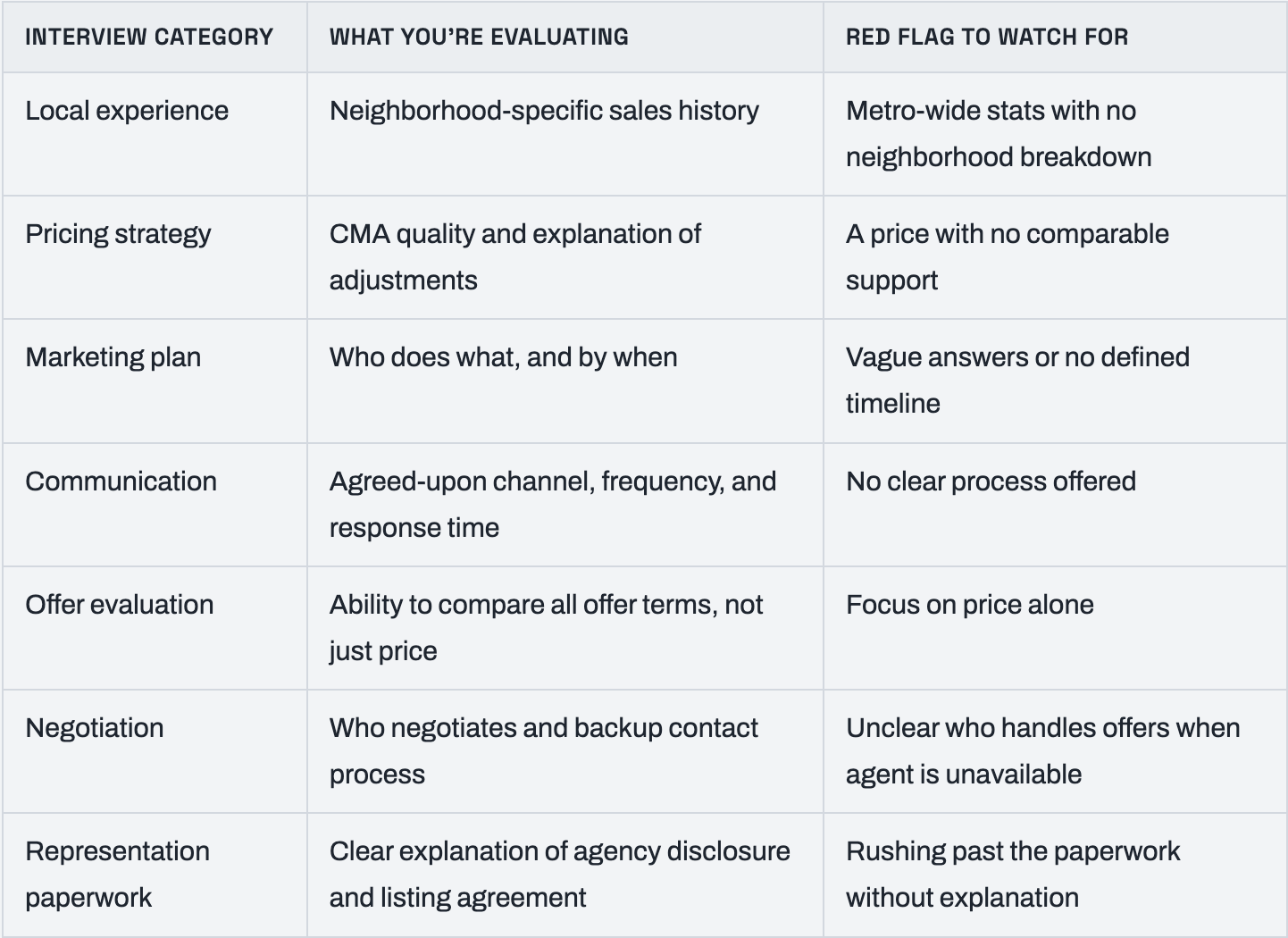
Metro-wide transaction counts don't tell you much. An agent might close 40 deals a year across the Twin Cities but have limited experience in your corner of Minneapolis or Saint Paul. Ask for neighborhood-specific numbers, and ask to see the actual listings. Recent experience in your submarket means the agent knows what buyers are paying, what they're skipping, and how long similar homes are sitting.
2. Can you show me a comparative market analysis using homes that actually compare to mine?
A real CMA identifies the comparable properties used, their sale dates, condition, square footage, location, and any concessions. It also explains why adjustments were made. Ask the agent to walk you through the logic, not just hand you a printout. The recommended list price should be tied to current competing listings, not just past closed sales from six months ago. This is exactly the kind of conversation I have with every seller before we talk about price, and if an agent can't explain their comps clearly, that's a signal worth noting. You can also read more about how to price your home in Minneapolis before your interviews so you know what a strong answer looks like.
3. What does your list-price-to-sale-price ratio look like, and can you break it down by property type?
This number tells you how close an agent's pricing lands to reality. A high ratio (close to 100% or above) suggests accurate pricing and strong negotiation. A pattern of price reductions suggests the opposite. Ask for the breakdown by property type and location, not just an average across everything the agent has ever sold.
4. How long do your listings typically take to go under contract, and how does that compare to the current market?
Days on market is a relative number. What matters is how an agent's listings perform against the current Twin Cities market average. The Minnesota Association of Realtors tracks monthly market data, and any agent worth hiring should be able to tell you where their own listings stand against it. If they can't, ask why.
Questions about marketing and preparation
How your home is presented to buyers in the first week on market has an outsized effect on final price. These questions reveal whether an agent has a real marketing plan or a generic one.
5. What would you complete before the listing goes live, and what is your expected timeline from preparation to market?
A strong answer covers repairs, professional photography, staging or decluttering guidance, floor plans or video, listing-entry preparation, and showing logistics. It also includes a realistic timeline. Vague answers like "we'll get it ready" tell you the agent doesn't have a defined process. According to NAR research, professionally photographed listings attract significantly more online views, and in Minneapolis, where buyers are often comparing multiple active listings simultaneously, first impressions matter.
6. Who personally handles photography, the listing description, video, and online syndication?
This is a question I encourage every seller to ask directly. Some agents handle all of this themselves or through a dedicated marketing coordinator. Others delegate to whoever is available. Ask specifically: who writes the listing description, who hires the photographer, who reviews the syndication to Zillow, Realtor.com, and other platforms, and who responds to showing requests. The answer tells you how seriously the agent treats the launch.
7. How will you keep me informed, and what can I expect in terms of communication?
Agree on this before you sign. Ask about preferred channel (call, text, email), expected response time, how quickly you'll hear about showings and buyer feedback, and how often you'll receive an activity report. Communication breakdowns are one of the most common complaints sellers have about agents, and they're almost always preventable when expectations are set at the start. I make a point of walking every client through this before we go live, because a seller who doesn't know what's happening is a seller who second-guesses their pricing unnecessarily.
Questions about negotiation, offers, and representation
This is where the real money is made or lost. A great marketer who can't negotiate is only doing half the job.
8. How do you evaluate an offer beyond the purchase price?
The highest nominal offer is not always the strongest offer. Ask the agent to explain how they compare financing type, contingencies, earnest money amount, closing date, possession timing, inspection terms, appraisal risk, and requested seller concessions. An all-cash offer at $10,000 below asking can net more than a financed offer at full price with a shaky appraisal gap. If an agent can't walk you through that analysis clearly, that's the answer you need. For a broader look at the selling process, the step-by-step guide to selling a house in Minneapolis covers what to expect from list to close.
9. Who will negotiate directly on my behalf, and who is my contact when you're unavailable?
Under Minnesota Statutes § 82.67, the seller's broker, or a salesperson licensed to that broker, acts on behalf of the seller. If you're working with a team, confirm whether the lead agent or a team member handles negotiation, who attends inspections or key meetings, and who you call when the lead agent is traveling. Know the backup process before you sign, not after an offer comes in at 9 p.m. on a Friday.
10. How do you handle multiple offers, and what is your strategy for maximizing my outcome?
This question reveals both experience and strategy. A seasoned listing agent in Minneapolis will have a clear process: how they communicate multiple-offer situations to buyers' agents, whether they use a deadline or a rolling review, and how they advise you on counter-offers versus best-and-final requests. There's no single right answer, but there should be a real answer, not a shrug and "it depends."
Questions about the listing agreement and representation paperwork
Before you sign anything, understand what you're agreeing to. This is the part of the interview most sellers skip, and it's the part that matters most if something goes wrong.
11. Can you walk me through the agency disclosure and what it means for how you represent me?
Minnesota law requires a licensed agent to provide an agency disclosure at the first substantive contact in a residential transaction, per the Minnesota Department of Commerce. That disclosure explains agency and nonagency relationship options and is not itself a contract. Ask the agent to explain it in plain language before you sign. A good agent welcomes this question. An agent who rushes past it is one to watch.
12. What does the listing agreement say about duration, termination, and what happens after it ends?
The listing agreement creates real contractual obligations. Ask about the term length, what it takes to terminate early, what services are specifically promised, and what obligations carry over after the agreement ends. Ask whether there are any fees or tail periods that apply if you sell to a buyer the agent introduced after the agreement expires. Read every line before you sign, and ask for clarification on anything that isn't clear. If you want to understand what a strong agent relationship looks like from the start, the post on how to find a reliable real estate agent in the Twin Cities covers what to look for beyond the interview itself.
Frequently Asked Questions
How do I choose the best listing agent in Minneapolis?
The best listing agent for your home is the one with verifiable, recent experience in your specific Minneapolis neighborhood or property type, a clear and data-backed pricing strategy, and a marketing plan they can explain in detail. Interview at least two or three agents, ask for neighborhood-specific sales data rather than metro-wide totals, and pay attention to how clearly and directly they answer your questions, that's a preview of how they'll communicate throughout the process.
Should I choose an agent who specializes in my Minneapolis neighborhood?
Neighborhood-level experience genuinely matters in the Twin Cities. What sells quickly in one Minneapolis submarket, at what price point, and with what buyer expectations can differ substantially from an adjacent neighborhood. Ask any agent you interview for recent comparable listings in your actual submarket, not just their overall transaction count across the metro.
How does a listing agent determine the right asking price in the Twin Cities?
A strong listing agent builds a comparative market analysis using recently sold homes that are similar in size, condition, location, and features to yours, then adjusts for meaningful differences and factors in current competing listings. The recommended price should reflect both what buyers have paid and what they're looking at right now. Ask the agent to walk you through the specific comparables they used and explain any adjustments, a good CMA is a conversation, not just a document.
What should a listing agent's marketing plan include?
At minimum, a marketing plan should cover professional photography, a written listing description, floor plans or video, syndication to major platforms, open house strategy, and a showing process with clear response expectations. Ask who personally handles each piece and what the timeline looks like from preparation to the first day on market. Generic answers ("we use all the major sites") are a signal the plan isn't well-defined.
What should I compare in listing agreements before choosing an agent?
Compare the agreement term length, what's required to terminate early, what specific services are promised in writing, and any tail or protection period that applies after the agreement ends. The Minnesota Department of Commerce notes that the agency disclosure is not a contract, but the listing agreement itself creates real obligations, read it carefully and ask for plain-language explanations of anything unclear before you sign.
The right listing agent in Minneapolis will answer every one of these questions clearly, back their claims with local data, and never make you feel pressured to sign before you're ready. That's the standard I hold myself and every agent on my team to. If you're preparing to sell and want to walk through these questions together, I'm happy to start that conversation, no obligation, no pressure, just clarity on what your home is worth and what a strong sale strategy looks like for your situation.
Schedule a consultation with Dan Winters and get straightforward answers about selling your Twin Cities home.
About Dan Winters
Dan Winters is a Minneapolis REALTOR® and founder of The Winters Real Estate Group at Coldwell Banker Realty, serving buyers and sellers throughout Minneapolis, Saint Paul, and the greater Twin Cities metro. Licensed since 2013, Dan has helped clients through more than 350 transactions and $120 million in real estate sales, consistently ranking among the top 3–5% of REALTORS® in the Twin Cities. His approach is built on one principle: real estate with clarity, not pressure. Every agent on The Winters Real Estate Group is a full-time professional committed to strong communication, skilled negotiation, and protecting each client's time, equity, and priorities.
Equal Housing Opportunity. This article is general information only and is not legal, tax, or financial advice. Confirm your specific costs, contract terms, and obligations with your closing agent, tax advisor, or lender.