

Greater Twin Cities Downsizing Guide Step by Step
How do you downsize your home in the Greater Twin Cities?
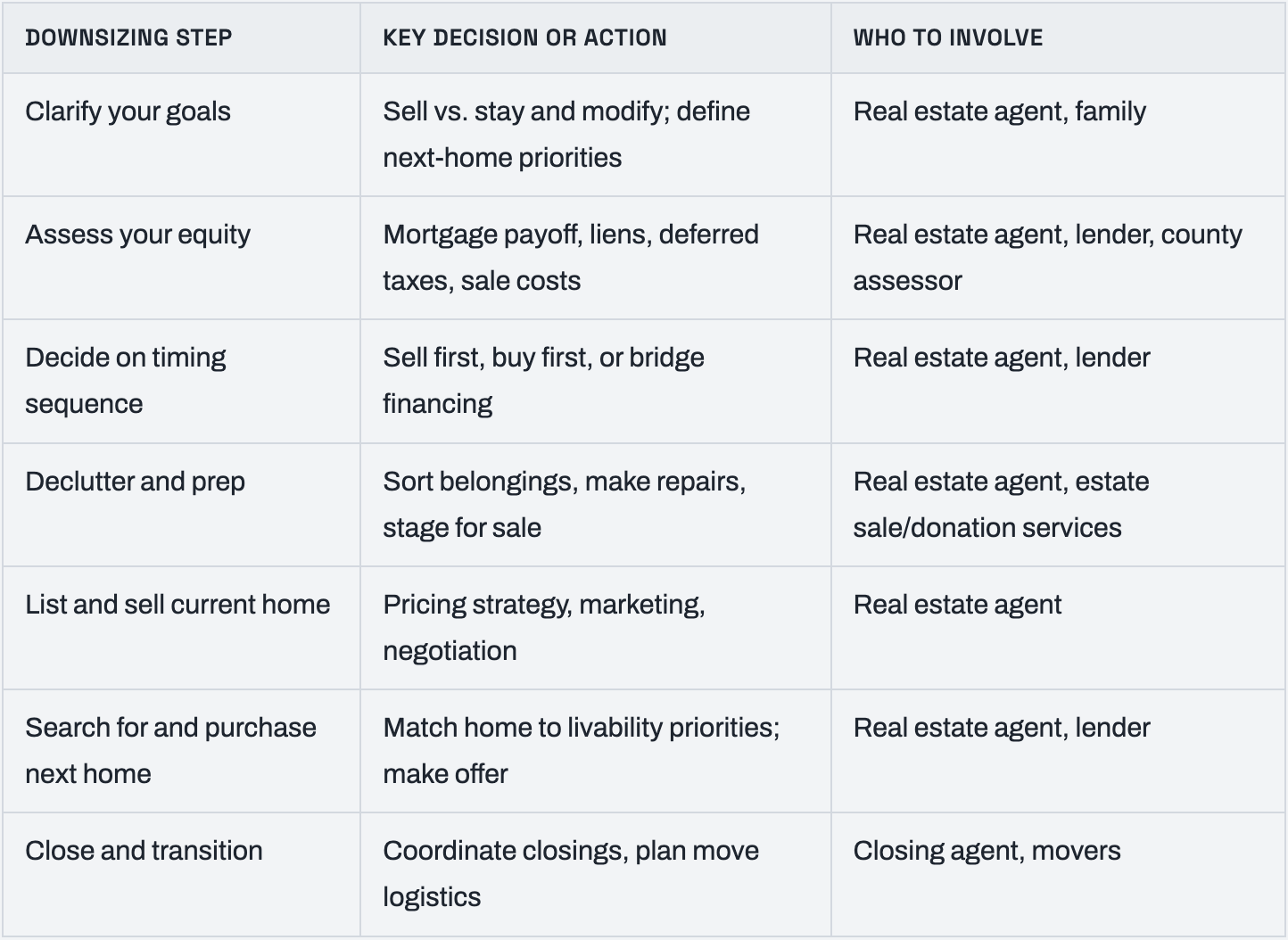
Downsizing in the Greater Twin Cities means clarifying your goals, getting an honest picture of your equity, decluttering before you list, selling your current home with a clear strategy, and then buying a smaller home that fits how you actually want to live. The steps are straightforward, but the sequencing and the financial details are where most people run into trouble, and that's where local guidance makes a real difference.
Key Takeaways
Your usable equity is not the same as your home's market value, it's what's left after your mortgage payoff, any liens, deferred taxes, and sale-related costs are settled.
Minnesota's Senior Citizens' Property Tax Deferral Program can cap annual property-tax payments at 3% of household income for qualifying homeowners age 65 or older with household income of $96,000 or less, but the deferred amount is a state loan that becomes due when the property is sold.
If you're considering applying for the deferral program, the deadline to defer taxes payable in 2027 is November 1, 2026.
Timing the sale of your current home and the purchase of your next one is the single most consequential decision in the process, buying first, selling first, and bridge financing all carry different risks.
Choosing a replacement home based on walkability, single-level layout, and proximity to medical care and transit often matters more than hitting a specific square-footage target.
I work with a lot of downsizers across the Greater Twin Cities, and the question I hear most often isn't "how do I sell my house?" It's "where do I even start?" The honest answer is: you start with clarity, not a listing appointment.
Here's the process I walk my clients through.
How do you know if downsizing is the right move in the Greater Twin Cities?
Before you call a mover or start scrolling listings, spend real time on this question. The answer shapes everything that follows.
What does your next chapter actually look like?
Some clients come to me knowing exactly why they want to move: the house is too big now that the kids are gone, the yard is more work than it's worth, or they want to be closer to family. Others are less certain, they feel like they should downsize but haven't fully defined what they're moving toward.
Both are fine starting points. But the clearer you are on what you want from the next home, a condo with no exterior maintenance, a single-level townhome, a smaller house with a walkable neighborhood, the easier it is to evaluate your options honestly.
Should you sell or stay and modify?
This is a question worth sitting with before you assume selling is the answer. Staying and modifying, adding a first-floor bedroom, a walk-in shower, or other accessibility features, can make sense if you love your neighborhood and your home is otherwise a good fit. The tradeoff is that modifications cost money and don't always add equivalent value at resale.
For qualifying homeowners who want to stay in place, Minnesota's Senior Citizens' Property Tax Deferral Program is worth knowing about. It's designed for homeowners who are at least 65 (or married couples where one spouse is at least 65 and the other at least 62), with household income of $96,000 or less and at least five years of ownership and occupancy. Under the program, your annual property-tax payment is capped at 3% of total household income, with the state deferring the rest.
Here's the part that matters if you're weighing selling: the deferred amount isn't forgiven. It's a state loan that accrues as a lien on your property and becomes due when you sell, transfer the home, or lose homestead eligibility. So if you defer taxes for several years and then sell, that deferred balance comes out of your proceeds. Factor it in before you treat it as free money.
The deadline to defer taxes payable in 2027 is November 1, 2026, a concrete planning date if you're deciding whether to stay through next year. You can confirm eligibility and current requirements directly with the Minnesota Department of Revenue or your county assessor.
There's also a statutory limit: if secured debts and other liens exceed 75% of the assessor's estimated market value, you may not qualify. The full rules are in Minnesota Statutes Chapter 290B, confirm the current calculation with the Department of Revenue or your county before relying on this program in your equity planning.
How do you figure out what your Twin Cities home equity is really worth?
This is where I see the most surprises. Online home-value estimates are a starting point, not a net sheet. Your usable equity, the money you actually have available for your next home, is a different number, and it's almost always smaller than the Zestimate suggests.
What goes into a real equity calculation?
A practical equity picture for a Greater Twin Cities downsizer needs to account for:
Your current mortgage payoff balance
Any home-equity loan or line of credit outstanding
Any liens on the property, including deferred property taxes if you've participated in the deferral program
Sale-related costs (agent fees, title, closing, repairs, staging, all negotiable or variable; confirm with your agent and closing agent)
Moving and transition costs
The purchase price, closing costs, and carrying costs of your next home
The only way to get a reliable number is to run it with someone who knows this market and your specific situation. I do this with every client before we talk about listing, it's the only way to make a confident decision about what you can afford next. If you want a realistic picture of your equity position, that's exactly the conversation to have before anything else moves.
According to the National Association of Realtors, homeowners who have lived in their homes for many years often hold significant equity, but the gap between gross equity and usable equity can be substantial once all the costs of a transaction are accounted for.
Should you buy first or sell first?
This is one of the most consequential decisions in a downsize, and there's no universal right answer. It depends on your financial cushion, your timeline, and current market conditions in the Twin Cities. I've written a detailed breakdown of the tradeoffs in my guide to sell before buying in the Twin Cities, worth reading before you commit to a sequence.
The short version: selling first gives you certainty about your equity and eliminates the risk of carrying two homes, but it can leave you in temporary housing if the right next home isn't available. Buying first gives you more control over your move, but it introduces financial risk if your current home takes longer to sell than expected. Bridge financing exists as a middle path, but it has its own costs and qualifications, verify the options with your lender.
What are the practical steps to sell your current home and move into a smaller one?
Step 1: Decide what stays and what goes, before you list
Decluttering is not a moving task. It's a pre-listing task, and it directly affects how your home shows and what it sells for. A home that reads as spacious and well-maintained gets more attention and better offers than one that looks crowded, even if the square footage is identical.
I tell every downsizing client the same thing: start with the rooms you use least. Go through storage areas, spare bedrooms, and the garage before you touch the main living spaces. Give yourself more time than you think you need, most people underestimate how long this takes by a factor of two or three.
For large furniture and items that won't fit in a smaller home, consider estate sales, donation, or consignment well before your list date. Starting this process three to six months before you plan to list gives you flexibility and reduces stress significantly.
Step 2: Prepare and price your current home strategically
Once you know what you're working with, the prep work begins. This typically includes a pre-listing walkthrough to identify deferred maintenance, cosmetic updates that are worth doing, and any repairs that could become negotiating points for a buyer.
Pricing is where I see sellers leave money on the table most often. Overpricing to "test the market" almost always costs more than it gains, a home that sits develops a stigma, and buyers start wondering what's wrong with it. The right price is the one that generates competitive interest from the start. For a deeper look at how to think about pricing, see my post on how to price your home to sell in Minneapolis without leaving money on the table.
For a full walkthrough of the selling process in this market, the step-by-step guide to selling a house in Minneapolis covers everything from listing prep to closing.
Step 3: Define what you need in your next home
This step runs parallel to the selling process, not after it. The clearer you are about your next home before you list, the better your timing will be.
For most downsizers in the Greater Twin Cities, the features that matter most aren't about square footage, they're about livability. Some of the most common priorities I hear:
Single-level living or a primary suite on the main floor
Low-maintenance exterior, condo, townhome, or a small lot with minimal yard work
Proximity to daily needs, groceries, pharmacy, medical care, and parks within a reasonable distance
Transit access for clients who want to reduce driving
Aging-in-place features, wider doorways, step-free entry, accessible bathrooms, or the ability to add them
HOA structure that handles exterior maintenance, if that's a priority
The AARP's livable communities resources have useful frameworks for evaluating a home's long-term fit, worth a look if aging in place is part of your planning.
Your specific priorities will shape where in the Twin Cities metro makes sense to look. There's a wide range of options across Minneapolis, Saint Paul, and the suburbs, from walkable urban condos to quieter townhome communities with strong transit connections. What matters most is matching the home to how you actually want to live, not just to a price point.
Step 4: Get pre-approved before you make an offer
Even if you're planning to pay cash from your sale proceeds, understanding your financing options before you need them gives you flexibility. If you're buying before you sell, you'll almost certainly need financing, and lenders have specific programs for bridge situations. The Consumer Financial Protection Bureau's homebuying resources are a solid starting point for understanding your mortgage options.
Confirm your numbers with your lender directly. What you can afford after the sale depends on your equity, your income, and what you're carrying into the next chapter, and that calculation is specific to you.
Step 5: Close and transition
In Minnesota, closings are handled by a closing agent. Your closing agent coordinates the title work, the transfer of funds, and the final paperwork for both your sale and your purchase. If the two transactions are happening close together, good coordination between your agent, your closing agent, and your lender makes a significant difference in how smoothly the transition goes.
Plan your move date with some buffer. Even well-coordinated closings can shift by a day or two, and having flexibility in your moving logistics reduces stress considerably.
Frequently Asked Questions
Should I buy the smaller home before selling my current Twin Cities home?
It depends on your financial cushion and current market conditions, there's no single right answer. Buying first gives you more control over your move and avoids temporary housing, but you take on financial risk if your current home doesn't sell quickly. Selling first gives you certainty about your equity but may require a short-term rental or extended stay arrangement. A bridge loan is a middle option, but it has its own costs and qualification requirements, talk through the tradeoffs with your agent and lender before you commit to a sequence.
Does Minnesota's senior property-tax deferral program affect my equity when I sell?
Yes, it does. The deferral program is not a grant, the state describes the deferred amount as a loan, and it accrues as a lien on your property. When you sell, the deferred balance becomes due and is paid from your proceeds. If you've deferred taxes for several years, that amount can be meaningful. Confirm your specific balance and how it will be handled at closing with the Minnesota Department of Revenue or your county assessor before you finalize your equity calculations.
How can I estimate the equity available for my next home without relying on an online estimate?
The most reliable approach is a comparative market analysis from a local agent, combined with a payoff statement from your lender and a review of any liens or deferred obligations. Online estimates don't account for your specific mortgage balance, liens, or sale costs, they're a rough starting point, not a planning number. I do this kind of equity walkthrough with every downsizing client before we talk about listing, because knowing your real number is the only way to make a confident decision about what comes next.
Which features should I prioritize in a downsized home for aging in place?
Single-level living or a main-floor primary suite is the most common priority. Beyond that, look for step-free entry, wider doorways, an accessible bathroom (or the structural ability to add one), and a kitchen layout that works well without a lot of bending or reaching. Proximity to medical care, pharmacy, and groceries matters more over time than square footage. The AARP's livable communities resources offer a useful checklist for evaluating a home's long-term fit.
What should I do with furniture and belongings before listing my house?
Start earlier than you think you need to, most people underestimate this by months, not days. Begin with rooms you use least (storage areas, spare bedrooms, the garage) and work toward the main living spaces. For large pieces that won't fit in a smaller home, estate sales, consignment, and donation are all worth considering well before your list date. A decluttered, well-staged home shows better, photographs better, and typically sells faster and for more money than one that looks crowded.
The bottom line on downsizing in the Greater Twin Cities
A successful downsize isn't just about finding a smaller home, it's about making a coordinated, financially clear move from one chapter to the next. The clients I've walked through this process who feel best about it are the ones who started with an honest equity picture, defined what they actually wanted in a next home, and gave themselves enough runway to do the decluttering and prep work without rushing.
If you're thinking about downsizing in the Twin Cities and want to start with a clear picture of where you stand, I'd be glad to walk through it with you. Schedule a conversation with me here, no pressure, just a straightforward look at your options.
About Dan Winters
Dan Winters is a Minneapolis REALTOR® and founder of The Winters Real Estate Group at Coldwell Banker Realty, serving buyers and sellers throughout Minneapolis, Saint Paul, and the greater Twin Cities metro. Licensed since 2013, Dan has helped clients through more than 350 transactions and $120 million in real estate sales, consistently ranking among the top 3–5% of REALTORS® in the Twin Cities. His approach is straightforward: real estate with clarity, not pressure. Every agent on The Winters Real Estate Group is a full-time professional committed to strong communication, skilled negotiation, and protecting each client's time, equity, and priorities.
Equal Housing Opportunity. This article is general information only and is not legal, tax, or financial advice. Confirm your specific costs, tax obligations, and financing options with your closing agent, tax advisor, or lender.